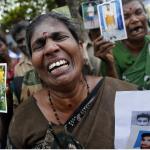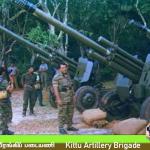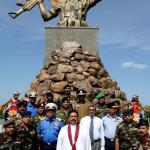

The transition from peaceful political advocacy to an armed struggle in the Tamil independence movement was not an overnight decision. It was the result of nearly three decades of failed negotiations, broken pacts, and escalating state violence.
1. The Failure of Parliamentary Politics
From 1948 to the mid-1970s, Tamil leaders like S.J.V. Chelvanayakam led a strictly non-violent, democratic struggle. They used Satyagraha (peaceful protests) to demand federalism and regional autonomy. However:
The 1972 Constitution: This new constitution removed the few legal protections minorities had (Section 29) and officially gave Buddhism "foremost place," making Tamils feel like second-class citizens in their own land.
2. State-Sponsored Violence and Pogroms
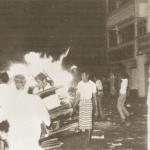
Non-violent Tamil protesters were repeatedly met with brutal violence by the state security forces and organized mobs.
Pogroms in 1956, 1958, 1977, and 1981 targeted Tamil civilians, homes, and businesses.
The turning point for many young Tamils was seeing that the state police and army either stood by or actively participated in these massacres. The logic became clear: If the state will not protect us, we must protect ourselves.
3. Educational and Economic Marginalization
In 1970, the government introduced the Standardization Policy. This required Tamil students to achieve much higher marks than Sinhalese students to enter universities (especially in Engineering and Medicine).
This effectively blocked the future of a whole generation of Tamil youth.
4. The Burning of the Jaffna Public Library (1981)
This was a cultural genocide that deeply wounded the Tamil psyche. The library, which housed over 95,000 irreplaceable manuscripts and books, was set on fire by state-sponsored mobs while high-ranking government ministers were present in Jaffna. For many, this proved that the state intended to erase not just their future, but their history as well.
5. The Vaddukoddai Resolution (1976)
By 1976, after decades of failed peaceful efforts, the major Tamil political parties came together to pass the Vaddukoddai Resolution. It declared that Tamils and Sinhalese were two distinct nations and that the restoration of a sovereign, secular, socialist state of Tamil Eelam was the only way to ensure the survival of the Tamil people. This resolution gave the moral and political mandate for the youth to begin the armed resistance.
Summary: The Path to Resistance
| Era | Method | Outcome |
|---|---|---|
| 1948–1956 | Parliamentary Debate | Ignored/Sidelined |
| 1956–1972 | Satyagraha (Non-violence) | Met with Pogroms & Broken Pacts |
| 1972–1983 | Formation of Armed Groups | Response to "Standardization" & Library Burning |
| Post-1983 | Full-scale Civil War | Following the Black July Genocide |
"When we were peaceful, we were slaughtered. When we asked for rights, we were imprisoned. The armed struggle was not our choice; it was the only door left open to us." — Common sentiment among the early resistance.

Leave a comment
Your email address will not be published. Required fields are marked *